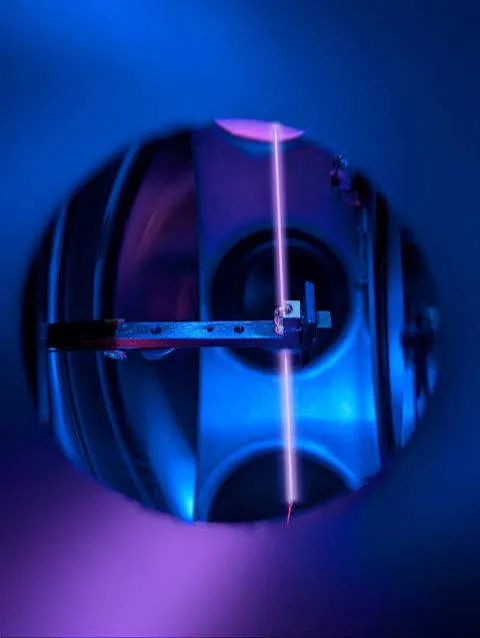
The world has entered a new age of precision timekeeping with the creation of the first operating nuclear clocks. Reported on October 7, 2026, in Nature, two independent teams have successfully built and tested prototypes that measure time using transitions within the atomic nucleus rather than electron movements.
A Shift from Electrons to Nuclei
One team is led by Thorsten Schumm of the Vienna University of Technology and Ekkehard Peik of PTB, the German National Metrology Institute. The other team is headed by Shiqian Ding of Tsinghua University in China. Both groups utilized thorium-229 nuclei trapped within crystals, using a laser tuned to specific frequencies to measure transitions between energy states.
Early Results and Potential
While these nuclear clocks do not yet surpass the stability of current atomic clocks—which can maintain accuracy to one second every 300 million years—researchers anticipate significant improvements. The Austrian clock achieved a precision of approximately one second every 30 million years, while initial tests show the Chinese prototype is about six times more stable. Scientists predict that future iterations could potentially achieve an uncertainty of just one second every billions of years.
Beyond Timekeeping
The implications extend beyond simply keeping time. These clocks offer a new tool for probing fundamental physics, including the search for elusive phenomena like dark matter. The unique properties of nuclear transitions may allow for more precise tests of established physical laws and open up entirely new avenues of inquiry.
Thorium-229: A Key Component
The clocks rely on thorium-229, a rare atom uniquely capable of exhibiting energy state changes within its nucleus when exposed to ultraviolet light at 148.4 nanometers. Researchers constructed specialized lasers and directed them at calcium fluoride crystals containing the thorium isotope to achieve functionality.



💬 Comments (0)